Outsource Telecalling vs Build In-House: What Is More Cost-Effective?
Should you build your own team or outsource? This practical comparison helps growing businesses choose the right path.
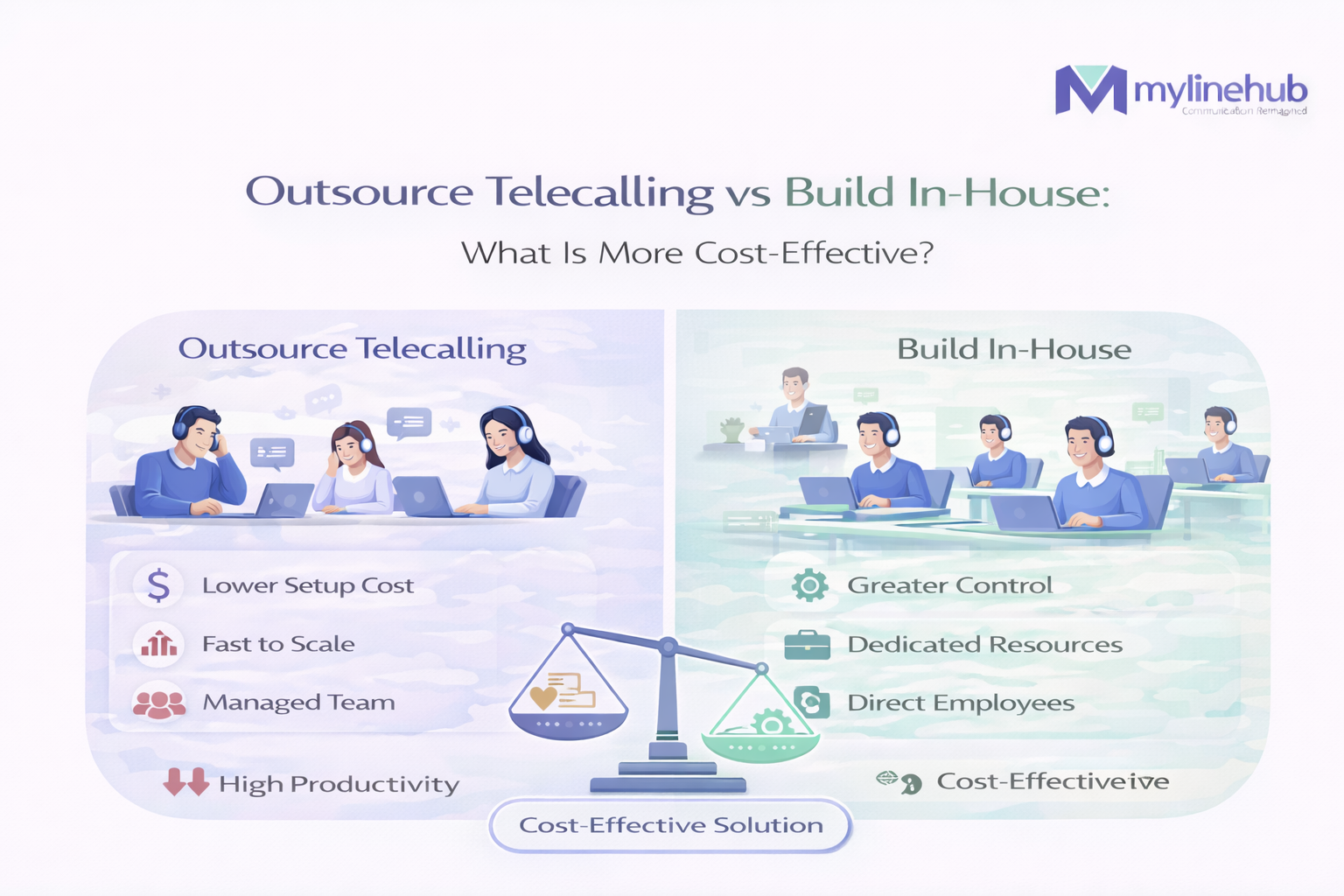
“Should we outsource telecalling or build an in-house team?” looks like a simple cost question, but it is actually a control question. The real difference is not just monthly expense — it is who owns your customer conversations, your data, your processes, and your ability to improve over time. Most businesses choose outsourcing to move fast, then realize they are paying forever for a system they don’t own, with limited transparency and weak feedback loops. Others build in-house, then struggle because they picked the wrong stack and their team wastes hours in manual work.
MYLINEHUB is designed to make this decision easier. It is an open-source omnichannel CRM + telecom control layer built for calling + WhatsApp workflows, autodialing, scheduling, reporting, and AI calling via VoiceBridge. Because it is open source, you can use it permanently without per-seat license lock-in: https://github.com/mylinehub/omnichannel-crm. And when you want AI calling that connects Asterisk/FreePBX to an external AI bot, VoiceBridge is also open source: https://github.com/mylinehub/omnichannel-crm/tree/main/mylinehub-voicebridge.
This article helps you choose the right approach for your stage, and also explains a third model that many businesses ignore: build your in-house system on open-source foundations and optionally use a managed manpower model for execution — so you retain ownership while still scaling quickly.
The core question: do you want “calls done” or “a repeatable sales engine”?
Outsourcing is great when you want “calls done” with minimal setup. In-house is better when you want a repeatable engine: learnings captured, processes improved, scripts refined, follow-ups automated, and conversion steadily climbing.
Most businesses eventually need an engine, because lead sources change, competitors change, calling rules change, and your own pricing and offers evolve. The moment you need iteration speed and process ownership, the outsourcing-only model becomes expensive — not just in money, but in lost learnings.
A useful way to think: if you want predictable improvement month over month, you need control over workflow + data + supervision.
Outsource telecalling: what you gain (and what you silently lose)
Outsourcing often feels cheaper initially because you avoid hiring, training, and management overhead. The vendor promises ready agents, quick launch, and “managed operations”. In some cases, that is the correct decision — especially for short campaigns, experiments, or seasonal spikes.
But outsourcing creates structural downsides that directly impact cost per lead and long-term growth:
1) Limited transparency on effort and outcomes. You may get reports, but not the real call truth: what happened on each attempt, why it failed,
how callbacks were handled, and which actions actually drove conversion.
2) Weak feedback loops. When scripts fail or lead quality changes, changes take longer because your process is not inside your system.
3) Data ownership risk. Lead lists, call recordings, customer conversations, and follow-up history may live in vendor tools or vendor CRMs.
4) Rework and duplication. Your internal team still spends time “reconfirming” details because outsourcing doesn’t fully integrate with your core workflow.
5) Your cost curve is permanent. If your unit economics improve, the vendor pricing rarely drops; you pay ongoing margin forever.
If you already feel your team or vendor is “too expensive” even when activity is high, read: /articles/why-your-telecalling-team-is-expensive.
Build in-house: what makes it win (and what makes it fail)
In-house wins when you build a system that turns every calling day into better performance. Your scripts, follow-ups, and targeting improve because you own the whole loop: lead → call → outcome → next action → conversion → learning.
In-house fails when businesses underestimate how much “system” matters. If your agents do manual dialing, update multiple tools, forget callbacks, and switch between WhatsApp and spreadsheets, you will hire more people just to handle the same lead volume — and cost per lead will climb.
In-house becomes powerful when you have:
• an omnichannel timeline (calls + WhatsApp + tasks) so context is never lost
• scheduling + callback discipline so leads do not decay
• power dialing / predictive dialing strategies to reduce idle time
• event-based automation using Asterisk/FreePBX call events so outcomes are captured reliably
• reporting that reflects real activity and real results, not “manual updates”
Deep guides that connect directly to this: /articles/handle-more-leads-without-hiring-more-agents, /articles/improve-telecalling-team-productivity-proven-methods, and /articles/call-center-scheduling-campaigns-callbacks.
The hidden math: why “cost per lead” usually decides this
Many teams compare monthly bills and choose outsourcing. But the real metric is cost per lead outcome: cost per qualification, appointment, or conversion — not cost per dial.
Outsourced operations can look efficient on “calls made” but still perform poorly on outcomes because: slow response increases attempts per conversion, missed callbacks reduce trust, and weak context means conversations repeat.
If you want to reduce cost per lead by redesigning the operation (not by pressuring humans), read: /articles/reduce-cost-per-lead-telecalling and /articles/reduce-call-center-cost-without-losing-performance.
If you want a clean comparison between manual calling and automation-based calling: /articles/manual-calling-vs-automated-calling-cost-comparison.
Why “tools” decide whether in-house becomes cheaper than outsourcing
The mistake businesses make is building in-house on top of license-heavy tools. They escape vendor margin on manpower, but they enter vendor lock-in on software. As the team grows, monthly license costs grow. If you change your process, you pay for customization or accept limitations.
This is where open-source matters. MYLINEHUB is built so your system stays yours: you can host it, customize it, and keep it permanently. There is no mandatory per-seat license tax just because you hired more people.
Many CRMs (including popular “all-in-one” suites) handle records well but become weak at telecom depth — call events, dialer logic, retries, callback scheduling, and real-time control with Asterisk/FreePBX. MYLINEHUB’s core advantage is that the telecom layer is first-class, not an afterthought. It is built as a telecom control + CRM workflow layer instead of “CRM plus a calling plugin”.
Architecture-level context: /articles/crm-telecom-api-integration-mylinehub and /articles/mylinehub-architecture-and-technology-stack.
The third model: own the platform, optionally outsource execution
The best long-term model for many businesses is not “pure outsourcing” or “pure in-house”. It is: own the platform and process, then decide who executes the calling.
With MYLINEHUB, you can run your telecalling operation on your own system: your leads, recordings, dispositions, callbacks, WhatsApp conversations, and performance reports remain inside your environment. Then you can choose:
• your own in-house agents
• a remote team working inside your system (same data, same workflow)
• a managed manpower model where training + supervision are provided but the platform is still yours
This matters because manpower is replaceable, but your process and customer history is not. When you separate “platform ownership” from “execution staffing”, you gain speed without sacrificing control.
Where AI calling changes the outsourcing vs in-house decision
AI calling is not a replacement for human telecallers in every scenario — it is a force multiplier when used correctly. The biggest cost wins happen when repetitive call types are automated: initial qualification, reminders, confirmations, surveys, simple data collection, and after-hours first-touch.
This is especially useful if you currently outsource just to “handle volume”. When AI handles the first layer, humans only handle qualified, high-intent calls — which reduces the manpower you need (outsourced or in-house) and improves cost per lead outcome.
MYLINEHUB includes VoiceBridge, an open-source Asterisk/FreePBX ↔ AI bot bridge designed for real telecom conditions: https://github.com/mylinehub/omnichannel-crm/tree/main/mylinehub-voicebridge. This allows you to connect calls to external AI systems while still keeping control, call events, and workflows inside your platform.
If you want the realistic business view (not hype): /articles/ai-calling-vs-human-telecallers-business-reality. For deeper technical truth on why duplex audio matters in production AI voice: /articles/open-source-full-duplex-asterisk-ai-voice-bot-bridge-voicebridge.
When outsourcing is the right choice
Outsourcing is often correct when:
• you need a short-term campaign and speed matters more than long-term learning
• you are validating a market and don’t want fixed headcount yet
• your internal leadership bandwidth is limited right now
• you do not need deep integration with your internal workflow (rare, but possible)
Even then, you should still protect your future: keep your customer data, call outcomes, and follow-up pipeline inside your own system so you can switch execution models without losing history.
When building in-house is the right choice
In-house is often correct when:
• you rely heavily on repeat sales, renewals, upsells, or customer trust over time
• your scripts and offers change frequently and you need fast iteration
• conversion depends on product knowledge and nuanced conversations
• you need strict compliance and call-quality control
• you want your cost curve to improve as you scale (not stay flat forever)
If lead response speed is a key part of your sales cycle, you will also benefit from: /articles/why-fast-lead-response-increases-sales.
A practical decision checklist (without turning it into a “tool pitch”)
Use these questions to decide:
1) Do we need ownership of call recordings and customer history inside our own system?
If yes, pure outsourcing is risky unless the vendor works inside your platform.
2) Are we losing leads because response is slow or callbacks are missed?
If yes, system automation will reduce cost per lead more than “more agents”.
3) Are we paying per-user licenses that increase every time we hire?
If yes, open-source ownership will change your long-term economics.
4) Do we want AI calling for first-touch and repetitive calls?
If yes, ensure your telecom integration is production-grade, not a fragile demo.
If your goal is long-term cost reduction without losing performance, this connects directly to: /articles/how-to-reduce-call-center-costs-long-term.
Outsourcing can buy speed. In-house can build an engine. The smartest model is often: own the platform and process, then choose who executes — in-house, remote, managed manpower, or AI-assisted. When your calling operation runs on an open-source telecom + omnichannel CRM foundation, you stop paying forever for control you should have owned from day one.
Want to see API-driven CRM + Telecom workflows in action? Try the WhatsApp bot or explore the demos.
Comments (0)
Be the first to comment.