How MYLINEHUB Helps Businesses Reduce Calling Costs and Scale Faster
See how MYLINEHUB combines open-source control, AI calling, and trained manpower to help businesses scale calling operations cost-effectively.
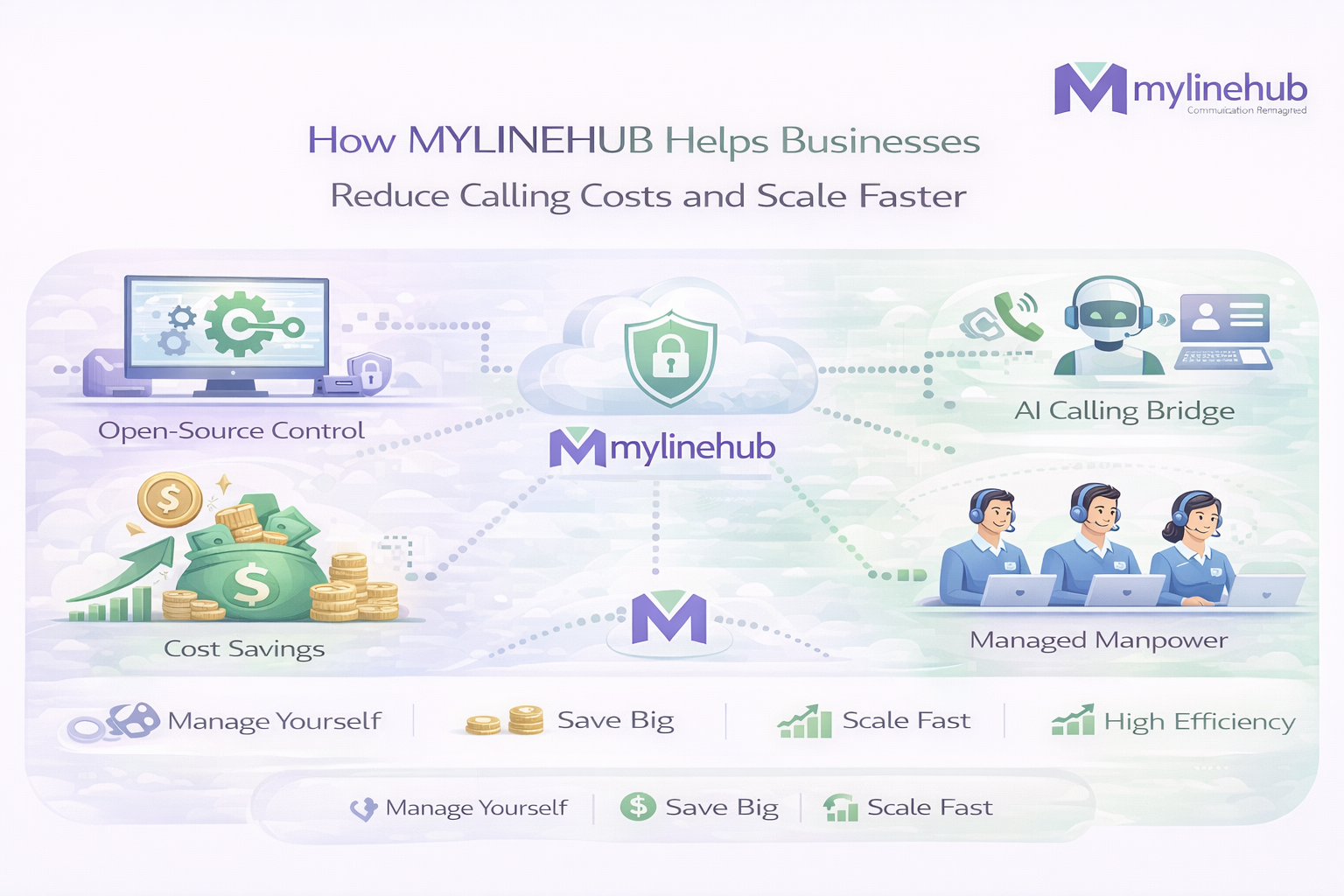
Cutting calling costs is not about “paying agents less” or pushing people harder. Long-term cost reduction happens when your calling operation becomes a well-engineered system: the dialer reduces idle time, the CRM enforces follow-ups, routing prevents wasted calls, reporting is trustworthy, and automation handles repetitive touchpoints without breaking customer experience.
MYLINEHUB is built exactly for this: an open-source omnichannel CRM + telecom control layer that integrates deeply with Asterisk/FreePBX, runs calling workflows with real telecom events, and scales without per-agent license traps. Core open-source repo: https://github.com/mylinehub/omnichannel-crm. It also includes an open-source AI calling bridge (VoiceBridge) that connects your telecom stack to external AI bots while keeping telecom control in your hands: https://github.com/mylinehub/omnichannel-crm/tree/main/mylinehub-voicebridge.
This article explains how MYLINEHUB reduces calling cost per lead, improves connect rates, increases agent productivity, and scales teams without forcing you into vendor lock-in. It also explains why many businesses overspend with “generic suites” that were not designed for telecom-grade operations.
The real cost of calling operations: where money leaks every day
Most call centers think cost = salaries + telecom bills. In reality, the biggest cost is invisible: wasted minutes. A 30-agent team that wastes even 20 minutes per agent per day is losing 10 hours of paid time every day. That “time leak” usually comes from:
• agents waiting between calls because calling is manual or the dialer logic is weak
• wrong retry logic (too early, too late, too often) reducing connect rates and burning leads
• manual notes, manual dispositions, manual follow-ups, manual WhatsApp updates
• missing customer context causing longer calls and repeated questioning
• poor callback discipline, so leads go cold and agents rework the same pipeline repeatedly
• reporting mismatches between CRM and telephony, so managers “manage by feelings” instead of facts
When you remove these leaks, cost drops without reducing quality. That is the only sustainable way to reduce cost at scale.
For a cost-focused foundation, see: /articles/how-to-reduce-call-center-costs-long-term and /articles/reduce-cost-per-lead-telecalling.
How MYLINEHUB reduces cost: system-level savings (not short-term hacks)
MYLINEHUB reduces calling costs by engineering the full operating loop: lead capture → assignment → dialing → outcomes → follow-ups → reporting. When this loop is automated and controlled by real telecom signals, the system becomes predictable and cheaper to run.
The savings come from five compounding advantages:
1) less agent idle time through dialer discipline and accurate call outcome detection
2) higher connect rate through retry logic driven by Asterisk events (not guesswork)
3) fewer missed leads through omnichannel fallbacks (WhatsApp/SMS/email + missed-call workflows)
4) reduced supervision load through clean monitoring + reliable reporting
5) lower long-term software cost because it is open source and can be owned permanently
The end result is simple: fewer agents can handle the same lead volume, and the agents you do have produce more useful outcomes per day.
1) Higher connect rate without agent fatigue: dialers that understand real call outcomes
Connect rate is not just “how good the list is”. It is also a telecom engineering problem. When your system knows exactly why a call failed (busy, no-answer, network failure, early hangup, unreachable, voicemail patterns), it can retry at the right time and avoid wasting attempts. Most low-cost dialers do not reliably detect these outcomes across real networks, which forces agents to guess and manually classify calls.
MYLINEHUB integrates with Asterisk/FreePBX and uses ARI-driven call events to classify outcomes and trigger the next action. That means your dialing strategy becomes consistent across agents and across campaigns.
This directly improves cost because:
• agents spend more time talking and less time clicking
• retries happen when a lead is more likely to answer
• fewer total attempts are needed to reach the same number of conversations
• abandoned leads drop because the system keeps the pipeline alive automatically
Deep dialer strategy guide: /articles/types-of-autodialer-strategies-explained and connect-rate engineering: /articles/increase-call-connect-rate-outbound-campaigns.
2) Automation that feels human: AI calling with VoiceBridge (open source)
Many teams try “AI calling” as a separate product and discover two problems: it doesn’t integrate with their real telecom flow, and it creates a second system of record. The result is messy: different logs, different outcomes, inconsistent reporting, and manual handoffs back to humans.
MYLINEHUB solves this with VoiceBridge: an open-source bridge between Asterisk/FreePBX calling and external AI bots. This is important because the AI layer becomes part of your real calling architecture rather than a disconnected tool. You can start with narrow use cases (lead qualification, verification, interview screening, appointment confirmation) and expand safely.
Cost benefits of AI calling, when integrated correctly:
• AI handles first-touch qualification so humans only speak to higher-intent leads
• AI handles follow-up reminders and confirmations, reducing “wasted callbacks”
• AI supports after-hours lead capture and scheduling so you don’t lose night traffic
• humans focus on closing and complex objections, not repetitive questions
VoiceBridge architecture and definition: /articles/open-source-full-duplex-asterisk-ai-voice-bot-bridge-voicebridge and production architecture overview: /articles/mylinehub-voicebridge-architecture.
Business reality (not hype): /articles/ai-calling-vs-human-telecallers-business-reality.
3) Fast lead response without hiring more agents
A lead is most likely to respond when interest is fresh. Slow response kills conversion and increases cost because you need more follow-ups and more attempts to get the same result. Most teams blame agents, but the real failure is pipeline design: leads arrive on multiple channels, routing is slow, and agents are not pushed the next best action.
MYLINEHUB is designed around omnichannel workflows so you can:
• capture leads from calls, WhatsApp, forms, and campaigns into one customer timeline
• trigger immediate calling attempts via dialer logic
• automatically follow up on WhatsApp/SMS/email when calls are missed or unanswered
• schedule callbacks properly so “call me tomorrow” is never forgotten
If you want to scale lead volume without scaling headcount at the same rate: /articles/handle-more-leads-without-hiring-more-agents and for speed-to-lead: /articles/why-fast-lead-response-increases-sales.
4) Reliable scheduling and callback discipline (compliance + conversion)
Inefficient teams call randomly. High-performance teams call systematically: respecting time windows, callbacks, and campaign pacing. When scheduling is missing, the same lead gets called too often or at the wrong time, which lowers connect rate and harms brand trust. It also creates compliance risk in markets with restricted calling hours.
MYLINEHUB treats scheduling as a first-class operational feature. This means campaigns and callbacks can be enforced by the system, not dependent on agent memory. That reduces wasted dials and improves customer experience at the same time.
Deep guide: /articles/call-center-scheduling-campaigns-callbacks.
5) Open source ownership: the most underrated cost lever
Many businesses reduce costs in the wrong place: they squeeze telecom rates and agent salaries, but accept software pricing that grows forever. The worst model for scale is per-agent pricing. It looks affordable at 5–10 agents, then becomes a tax at 50, 100, 300 agents. At that point, the business is trapped: switching costs are high, data migration is painful, and workflows are locked.
MYLINEHUB is open source so you can own the system permanently. This changes the economic model:
• no mandatory per-seat licenses just to keep your workflow running
• the system can be deployed in your environment (on-prem or controlled infra)
• your data stays yours, and integrations can be built deeply
• you can customize small parts of code when needed, instead of waiting for vendor roadmaps
This does not mean “free means low quality”. In telecom, quality comes from architecture, observability, and operational discipline. Open source simply means you have control and can build long-term stability without paying rent forever.
More on pricing reality: /articles/why-per-agent-pricing-expensive-at-scale and data ownership: /articles/how-to-make-sure-your-business-data-remains-yours.
Why MYLINEHUB scales better than “generic CRM suites” for calling
Generic CRM suites are usually built for pipeline tracking, not for telecom-grade calling operations. They can store leads and tasks, but they struggle with deep telephony control: real call events, dialer logic, queue behavior, retries, recordings, and high-concurrency planning. That’s why many businesses end up stitching together multiple tools and paying multiple vendors.
MYLINEHUB is telecom-first. It is designed around Asterisk/FreePBX integration and scales by decoupling telecom infrastructure from the CRM control layer. This is the architecture pattern that avoids single points of failure and supports growth.
If you want the architectural reasoning: /articles/how-to-build-scalable-telecom-solution and multi-Asterisk control: /articles/loosely-coupled-multi-asterisk-architecture-mylinehub.
Scaling teams is not only software: training + supervision model
Software reduces waste, but people still matter. Call centers scale when new agents can become productive quickly and consistently. That requires training, scripts, monitoring, and a feedback loop that improves over time.
MYLINEHUB supports this operational maturity by making call data and outcomes structured and auditable: recordings, dispositions, callback history, and performance signals become consistent across the team. This reduces the cost of supervision because managers spend less time “finding the truth” and more time coaching the right behaviors.
Monitoring done correctly: /articles/how-to-track-call-center-employees-effectively and productivity methods: /articles/improve-telecalling-team-productivity-proven-methods.
What this looks like in real business scenarios
MYLINEHUB is used when businesses want one of these outcomes:
• reduce cost per lead without reducing customer experience
• scale outbound campaigns while improving connect rate
• handle more leads without hiring proportionally more agents
• combine human agents + AI calling in one operational stack
• avoid per-agent license traps and build long-term ownership
If you are comparing manual vs automated economics: /articles/manual-calling-vs-automated-calling-cost-comparison. If you are planning a full operation setup: /articles/setup-high-performance-calling-operation-business.
Cost reduction is not a one-time project. It is what happens when the calling stack becomes an asset you own: open source, telecom-grade, deeply integrated, and built to evolve with your business.
Want to see API-driven CRM + Telecom workflows in action? Try the WhatsApp bot or explore the demos.
Comments (0)
Be the first to comment.